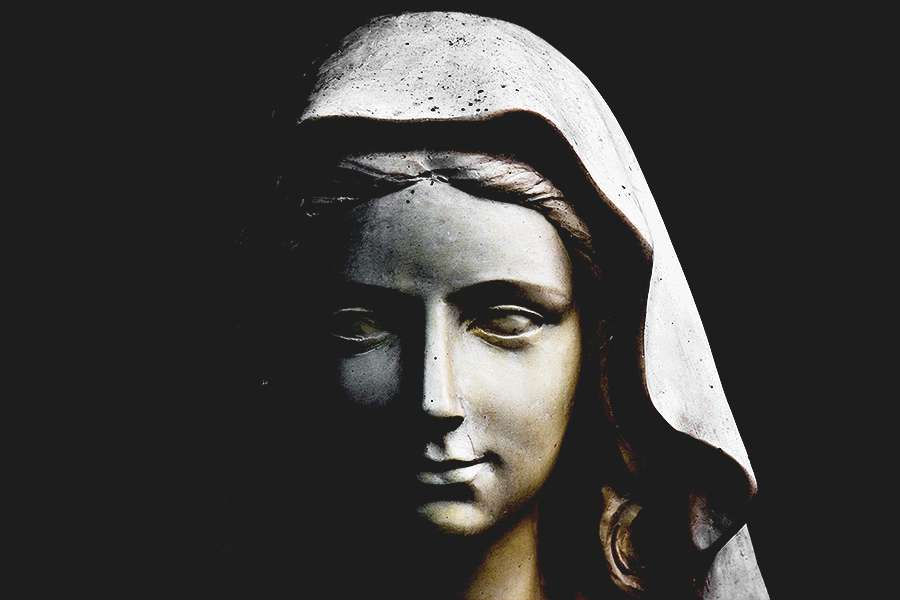
God Reels
I was texting with a friend who uses a microphone to create texts. The phrase my friend was saying was "guard rails", but what came across my phone in text was "God reels". As a person who is sensitive to the way God often speaks quite softly through seemingly incoherent promptings, I was delighted with this erroneous phraseology. "God reels" exactly describes the seeings or many times hearings or feelings that later turn out to be signposts along the way of our spiritual path, our pilgrimage. It happened to me just last week.
I was preparing for participation in AuroChit's presentation at an international conference on the Discovery and Application of Veda, for which AuroChit (a group dedicated to that exact mission) was among the organizers. I had already created a four-minute video to express my research on finding Veda in Christianity in case the internet connectivity was faulty on the day of the presentation. Then, inexplicably (to me) I awoke one morning trying to remember the Latin lyrics to St. Thomas Aquinas' Eucharistic hymn O Salutaris Hostia, words I had sung every Thursday for years at St. Louis Church during Holy Hour. I struggled all day to recall the words. Why? Why was that hymn on my mind as I awoke? Why was I compelled to think through the text? Being familiar with God reels, I just pursued it and let the questions hang unanswered.
Later that afternoon I lay on my bed for a five-minute rest, when suddenly I knew I should look up the text. I did, copied it down, then copied down the literal English translation (not the fancied English lyrics we sometimes hear used in church).
O salutaris Hostia
Quae caeli pandis ostium:
Bella premunt hostilia,
Da robur fer auxilium.
Uni trinoque Domino
Sit sempiterna gloria,
Qui vitam sine termino
Nobis donet in patria. Amen.
O saving victim,
Who expands the door of heaven,
Hostile armies press,
Give strength; bear aid.
To the One and Triune Lord,
May there be everlasting glory;
Who life without end gives us
In the homeland. Amen.
That could easily be a correct English translation (using Sri Aurobindo's keys) of a Vedic hymn. What followed was a realization.
Regardless of race, language, nation, gender, age, orientation, level of education, economic status, or any other individualizing marker, we are all children of Veda. Sanatana Dharma (Hinduism), which embraces all religions, is built on the foundation of Veda. Therefore, all religions, all culture, everything is built on the basis of Veda, the oldest known spiritual texts. Veda is India's gift to the world. India preserved the Sanskrit texts unchanged from antiquity until now through meticulous oral tradition. Now, with Sri Aurobindo's keys and The Mother's grace, these ancient texts, which outline the spiritual evolution of humanity's pilgrimage toward union with the Divine and the divinization of the world, are available to everyone who has the aspiration to seek the Divine and the divine life, heaven on earth. Veda is our common ancestry, describes both our common source and our common destination. Veda represents a vehicle for human unity.
That is a God reel.
Comments